

How to Use CALF
Better Practice vs Best Practice
CALF is not an exhaustive database of all the laws and policies affecting farm animals, but rather, a collection of what we see as some of the better laws and policies from the perspective of farmed animal advocacy. Importantly, we do not describe these laws as ‘best practice’. While these laws are some of the best around the world in terms of treatment of animals and sustainable food systems, they still fall far short of ‘best practice’. CALF describes the strengths and weaknesses of each law and policy. However, the details of each law and policy must be considered in the context of their respective local political contexts. While this database points towards better and worse practices, this must be supplemented by a strong understanding of the local political and regulatory environment. What is good practice in one jurisdiction may not be legally or politically feasible in another.
Use Cases
CALF is purpose built for policymakers, researchers, and advocates. Anyone who wishes to build sustainable food systems, and phase out industrial animal agriculture, will be able to find concrete legal and policy recommendations to influence law and policy. CALF was created with the following five uses in mind;
1. Explore levers for change
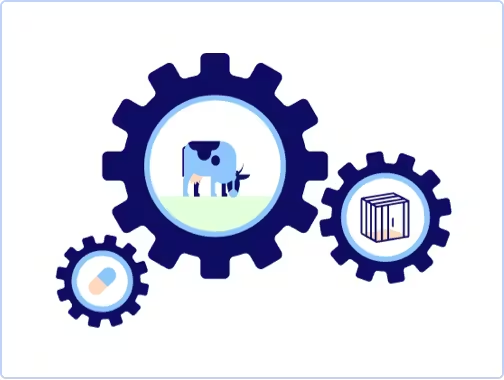
Selecting from the list of law and policy fields, you can learn about different levers to phase out factory farming beyond agricultural and animal welfare legislation. For instance, restrictions on antibiotics use tend to improve animal welfare by necessitating the reduction of stocking densities on farms. Further, regulations put in place to curtail nitrogen emissions require the reduction of manure levels, in turn requiring fewer animals on a given farm.

2. Read about specific laws
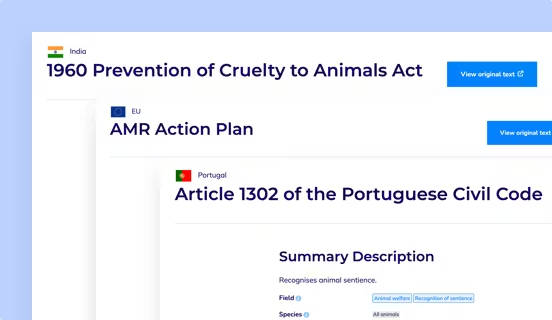
CALF allows you to easily view key information about each law and policy. The database provides a concise overview of each entry, linked to a separate page with more information. Each database entry contains a short description of the entry, strengths and weaknesses, enactment date, official citation, and a link to the official text.

3. Draft laws based on existing documents
Users will be able to draw on existing texts to draft new legislation. Texts assembled in the database allows users to grasp the general tendencies that jurisdictions follow in regulating certain fields. For instance, when it comes to the use of antimicrobials, certain jurisdictions emphasise monitoring through surveillance systems, while others insist on rules or guidelines limiting the use of certain substances, with almost all jurisdictions aiming to reduce the use of antimicrobials in animal agriculture.
4. Compare laws and policies between countries
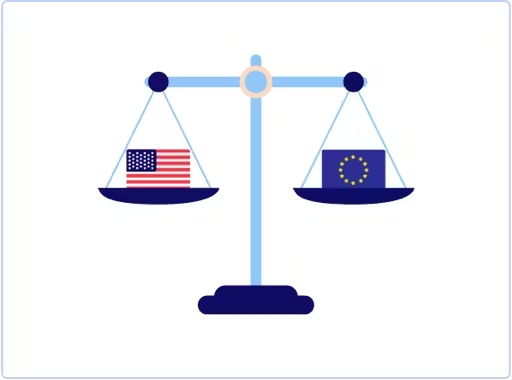
CALF enables users to compare legislation and policies across jurisdictions. Such a comparison allows you to get up to speed on differing international developments in a range of relevant fields. For instance, several jurisdictions in Europe have recognised animal sentience, with some requiring the State to enact provisions to protect animals. Comparisons also provide insight into the feasibility of particular reforms and how one’s own jurisdiction ranks on farmed animal welfare compared to others.

5. Learn about key topics
Through its factsheets, CALF summarises and analyses key topics in industrial animal agriculture law and policy. Each factsheet presents background information on the topic, key considerations for enacting laws and policies related to the topic, and a review of better and worse practices
The Coller Animal Law Forum is part of Jeremy Coller Foundation, a registered charity (No. 1163970) and a company limited by guarantee (No. 9696841) in England and Wales. | Copyright @ 2026